山演算
The Mountain Algorithms
- 展覽期程|2024.8.17-2024.11.24 (週二至週日,上午9:30至下午5:30 (週一、除夕休館))
- 展覽地點|高雄市立美術館104、105展覽室
- 策展人|呂岱如、卡羅琳娜.蓋斯洛赫凱拉
- 參展藝術家|法蘭達.巴瑞托、塔尼亞.坎迪亞尼、派翠西亞.多明格斯、黃鼎云、余欣蘭、康雅筑、吳松吉、妮可.勒希里耶、lololol 、羅智信、大米釀造姐妹俱樂部、奧斯卡.桑蒂安、徐世琪、蘇郁心、陳業亮、康絲坦薩.阿朗孔特南、王永安、黃漢沖、吳其育
- 活動資訊

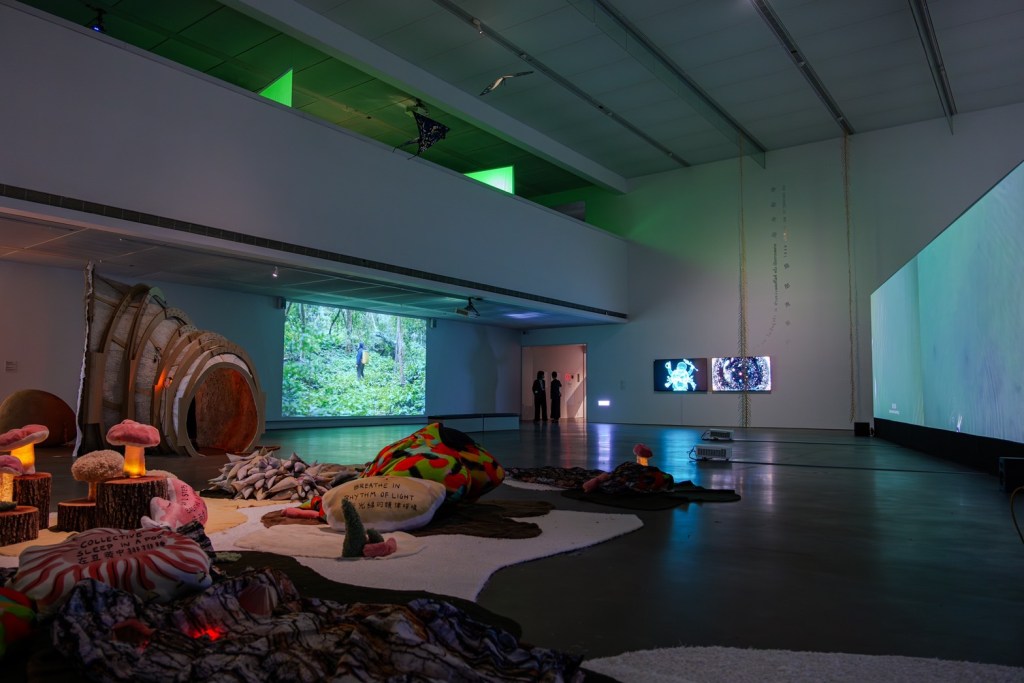


Photo credit:Wu Chi-Yu 吳其育
《山演算》試圖把時間與地理的物理維度展開,將自然宇宙的智慧與人工智慧並置探索,呈現幾種理解未來生態思考與實踐的羅盤,並尋思「生態藝術」的嶄新意義:落實在我們如何運作與擴延我們的身體感官覺知、怎麼在自然技術與人造技術之間創造有機過程與合作運用、更加重視精神性與文化性的生態思維、學習不同的節律與代謝方案、如何創造生態社群、循環與關係。
而藝術在其中,怎樣思考這其中高度複雜的、不穩定的、看似正在崩解的各種網絡關係狀態,用不同的政治性讓讓生態真正成為一種結盟、文化與力量。這些傾向生態女性主義思維的方法,由來自亞洲與拉丁美洲兩個區域內的藝術家所提出,如此取樣方式也讓我們有意識地從更多不均等的解殖脈絡裡,去思考歷史進程、環境變遷的聯繫,並且呈現出多重各異的世界觀。
【山羌、女兒與她的獵場:《揹獵物的女人》系列影像與裝置藝術創作展】
Pada、saan maduk laqi kuyauh:Mapa ka kuyuh samat nii.(太魯閣語Truku language)
Muntjac, Daughter, and Her Hunting Grounds:Image series from “The Woman Carrying the Prey”.
- 策展人|黃瀞瑩
- 藝術家|Rngrang.Hungul 余欣蘭
- 展覽主題|山羌、女兒與她的獵場:《揹獵物的女人》系列影像
- 展覽期程|2023年8月16日至12月31日 (週六至週日08:30-17:30)
- 展覽地點|臺灣原住民族文化園區 文物館特展室(屏東縣瑪家鄉北葉村風景巷104號)
- 活動資訊
本展「山羌、女兒與她的獵場:《揹獵物的女人》系列影像」,嘗試透過《我是女人,我是獵人:筆記版》、《揹獵物的女人》、《我是女人,我是獵人:錄像裝置》,以及現地裝置,呈現余欣蘭於2020年至2024年間聚焦於女獵人Heydi.Mijung的身體樣態與生命經驗,所進行的影像紀錄、觀察筆記、聲響實驗與延伸性書寫計畫。
2020年,在《Mgaluk Dowmung正要連結銅門—銅門家族的故事》拍攝期間,余欣蘭(Rngrang.Hungul)為了追蹤家族的技藝傳承關係,意外補遺了家族勞動史中的陰性敘事。那些置身在族群的性別分工(與二元性別想像)之外的女性狩獵採集者,自此開始成為她的目光與鏡頭持續追蹤的身影。
這讓作為影像創作者的余欣蘭,第一次能夠緩慢而綿長地凝視著母親Heydi.Mijung的身體,這位太魯閣族的女獵人以及她所哺育的萬物。Heydi.Mijung是一個虔誠的長老教會基督徒,在日常生活中同時堅守太魯閣族的Gaya,她關照家族裡出現的「spi」(太魯閣語的「夢」),以其生命智慧理解親人與兒女的「bhring」(太魯閣語,近似中文語境的「能力或氣場」,但具有靈方面的指涉),時刻覺察並調適人與人、人與自然、人與超自然之間的關係。作為一位曾伴隨家族走過艱難時刻的女性,Heydi.Mijung長期日夜兼工,在工地、安養院、砂石場、病房、快炒店裡,以其自身的勞動力換取兒女的下一頓食糧。正是在這樣的精神世界與生活世界裡,她成為了一個太魯閣族的女獵人,在年復一年的狩獵季節裡,返回她所熟悉的獵徑,看望她的獵場,與那些曾經看望著她的眼睛—包含對她有特殊意義的山羌,以及開始走在她身後的女兒,再次對視。
在「山羌、女兒與她的獵場:《揹獵物的女人》系列影像」中,我們希望能夠呈現出複雜卻真實的認同流動與性別敘事,同時在這個看似作為例外狀態的「女獵人」身影中,再次閱讀到一種關注永續性及平衡性的Gaya生命哲學,及其可能的當代詮釋。
The exhibition Muntjac, Daughter, and Her Hunting Grounds: Image series from “The Woman Carrying the Prey” combines elements from the films I’m a woman, I’m a hunter: The Director’s Edition; The Woman Carrying the Prey; and I’m a Woman, I’m a Hunter, as well as installation, with the aim of presenting film documentation, observatory notes, experimental sound, and Rngrang Hungul’s extended writing project (2020-2024), placing focus upon the body movement and life experience of female hunter Heydi Mijung.
In 2020, during the shooting of Mgaluk Dowmung, Connecting with Dowmung – The stories of Dowmung families, whilst tracing the relationships present in passing on family skills and craftsmanship, director Rngrang Hungul inadvertently caught on camera the feminine narratives present within the labor history of her own family. Since this moment, these female hunter-gatherers, who stand somewhat outside the gender-based division of labor (and thus the binary gender imagination) of the community, have become the central figures that her eyes and camera continue to trace.
In this way, as a filmmaker, Rngrang Hungul was able for the first time to gaze slowly and longingly at the body of her mother, Heydi Mijung – female hunter of the Truku tribe, and all that she nurtures. Heydi Mijung is a devout Presbyterian Christian who, at the same time, adheres to the Gaya of the Truku in her daily life. She cares for the “spi” (“dream” in the Truku language) that arises in her family, uses her life wisdom to understand her relatives’ and children’s “bhring” (similar to the Mandarin for “ability” or “aura”, but with a more spiritual connotation), and through awareness is able to adjust the relationship between people, people and nature, and between people and the supernatural. As a woman who has steered her family through difficult times, Heydi Mijung spent many years working day and night in construction sites, nursing homes, quarries, hospital wards, and the non-stop frying of stir-fried food kitchens, exchanging her labor to ensure enough food for her children’s next meal. It is between these spiritual and material worlds she became a Truku female hunter, returning year after year each hunting season to the trails she knows so well, looking once again at those grounds and seeing again the eyes that once looked at her – including those of the Muntjac, which has a special meaning for her, and her daughter, who has started walking behind her.
In the exhibition Muntjac, Daughter, and Her Hunting Grounds: Image series from “The Woman Carrying the Prey”, we hope to present a complex yet authentic narrative flow of identity and gender. At the same time, in the figure of the “female hunter”, one which appears to exist in a state of exception, we can once again read Gaya’s philosophy of life, which is concerned with sustainability and balance, as well as its possible contemporary interpretations.
 Rngrang.Hungul